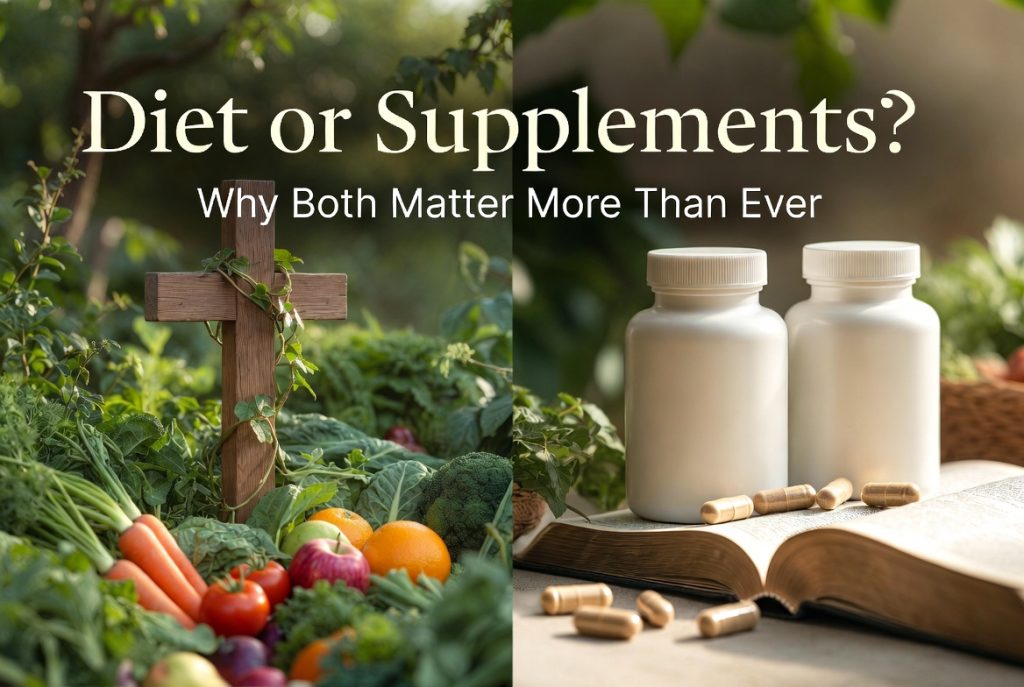
There’s a longstanding debate, especially on social media, about what’s more important for health: a good diet or supplements. Some people insist we should get everything from whole foods and avoid supplements entirely. Others pop a handful of pills every morning like it’s breakfast.
So who’s right?
I believe the answer is both. Here’s why:
What the Bible Says About Food and Our Bodies
From the very beginning, God designed food as our primary source of nourishment. In Genesis 1:29 we read:
“Behold, I have given you every plant yielding seed that is on the face of all the earth, and every tree with seed in its fruit. You shall have them for food.” (ESV)
Fruits, vegetables, and plants were meant to sustain us. After the flood, God expanded that provision in Genesis 9:3:
“Every moving thing that lives shall be food for you. And as I gave you the green plants, I give you everything.” (ESV)
Protein from animals became part of the picture. Yet even with this broader diet, the world changed dramatically. Overfarming, soil depletion, chemical use, and thousands of years of genetic degradation mean today’s food isn’t the same as what Adam and Eve or even Noah had access to.
We were formed from “the dust of the ground” (Genesis 2:7) — perfectly mineral-balanced earth. After the Fall, decay entered the picture. Lifespans shortened. The soil changed. The Flood reset the world. And here we are, 6,000+ years later, trying to thrive in a broken system.
A healthy diet of fruits, vegetables, and quality protein is still the foundation. But in our modern world, it’s nearly impossible to get everything our bodies need from food alone.
My Personal Approach
I eat as cleanly as possible: lots of vegetables, fruits, good proteins, and minimal processed junk. And I take a handful of targeted supplements every day.
Why? Because soil nutrient levels have dropped significantly over decades. Many of us are stressed, sleep-deprived, and exposed to toxins that increase our nutritional needs. Diet gets us most of the way there. Supplements help fill the inevitable gaps.
The Multivitamin Trap
Many people think a single daily multivitamin solves the problem. Unfortunately, most mainstream multis fall short.
Here’s a clear visual comparison:
One-A-Day Women’s Multivitamin provides only 42 mg of magnesium (just 10% of the Daily Value) and 1,000 IU of Vitamin D. It doesn’t disclose the form of magnesium (which affects absorption) and contains zero Vitamin K2.

Compare that to targeted options:
- A good magnesium glycinate often delivers more elemental magnesium in a highly absorbable form.
- A quality D3 + K2 supplement can provide 5,000 IU of Vitamin D plus K2 to help direct calcium properly — something most multis completely lack.
The pattern repeats across many nutrients. Multis are convenient, but they’re often formulated with minimal doses and cheaper forms.
The Takeaway
Eat real food. Prioritize vegetables, fruits, quality meats, healthy fats, and fermented foods. Then supplement wisely, focusing on nutrients you’re likely deficient in (like magnesium, Vitamin D, omega-3s, etc.) rather than hoping one pill covers everything.
Healthy living in a fallen world requires wisdom, diligence, and balance. There’s no one perfect trick. It takes both diet and smart supplementation.
What’s your current approach: mostly diet, heavy on supplements, or somewhere in between? Drop a comment below. I’d love to hear your thoughts as we explore nutrition, supplements, and faith-based wellness together.
Welcome to the first post of this nutrition and supplements blog. Future posts will dive deeper into specific nutrients, product reviews, and practical ways to optimize your health.
Share this post if it resonated with you!
Leave a Reply